

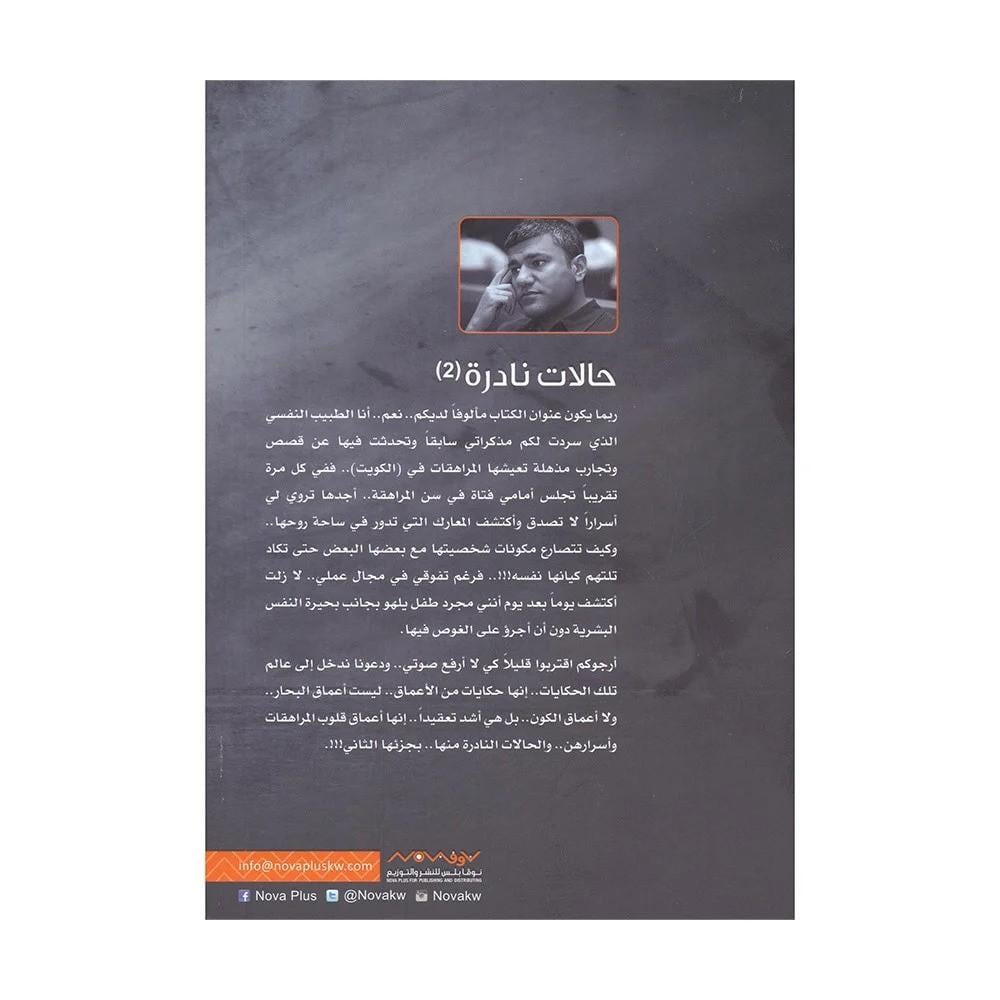



📚 This distinguished book is presented through Biak Library, taking the reader on a mysterious journey into the depths of the human psyche, where truth blends with fantasy, and secrets are revealed between the pages. This literary work is written in a dazzling style that touches the reader with emotion and amazement, leaving a lasting impression.
- 🖋️ Author: Abdulwahab Al-Sayed Al-Rafaei
- 📅 Publication Date: 2015
- 🗂️ Book Category: Literature and Poetry
- 📚 Publisher: Nova Plus Publishing and Distribution
- 📖 Number of Pages: 345 Pages
- 🏷️ Language: Arabic
- 📘 Book Format: Paperback
A Focused Glimpse
The book "Rare Cases 2" by Abdulwahab Al-Sayed Al-Rafaei paints a vivid picture of a psychiatric clinic where sessions transform into vibrant narrative scenes, capturing the subtlest cues preceding and following a confession. These cues include a change in voice pitch when an old wound is touched, a shoulder tilt when half a truth is told, or a silence laden with more than words can bear in that brief, heavy moment. From this sensory fabric, each case develops a distinct psychological map that points to the root of the pain and demonstrates how familial pressures and social control intertwine with the fragility of age to create internal narratives that defend the self as much as they confuse it. Each story becomes a calm exploration of the meaning of survival in an environment crowded with expectations.
Writing Style
The style is based on a calculated linguistic economy that favors the power of observation over the clamor of description. Short sentences emerge as successive pulses when the tension of confrontation rises, then sentences lengthen and undulate as the unconscious rises to the surface. The rhythm mimics the fluctuations of mood and translates the character's anxiety into palpable internal music. With this stylistic mastery, the narrator maintains a compassionate moral distance, granting the characters the right to narrate their version first, before intervening with professional reflections that reveal defense mechanisms and rename symptoms without preconceived notions. This balance generates a readerly confidence that allows the case to be read as a life, not as a static file.
Themes of the Work
The themes revolve around questions of identity, memory, the body, and choice. They trace how adolescence reframes its relationship with the past in the form of small secrets that escape from everyday language into contradictory behaviors. These secrets manifest in acute hesitation, tendencies of control, or a desire to escape, while the impact of delayed traumas, skillfully disguised within polite social discourse, pervades them. Throughout these stories, the limits of obedience, belonging, and the ability to name are tested. Here, confession is not merely a dramatic goal, but a therapeutic step that organizes consciousness and opens a window to self-understanding beyond the confines of fear and shame.
Narrative Structure
The stories are organized into independent files, supported by a unified stylistic thread. Scenes are constructed with focused sensory shots that establish the place and moment, and they rely on economical dialogues that allow spaces to function semantically, so that what is not said becomes part of the meaning, not a deficiency in the statement. As each story progresses toward a carefully considered point of revelation, a margin of creative ambiguity is maintained, allowing for multiple interpretations of what is objective and what is subjective perception. The reader remains a partner in constructing meaning, not a recipient of a final, complete result.
Artistic Value
The work presents a contemporary Arab model of psychological narrative that combines the pleasure of suspense with the rigor of observation, eschewing easy metaphysical influences in favor of an internal tension that can be understood and renamed. Its appeal stems from its ability to transform the clinic into a miniature theater of the human conscience, where language is tested as a therapeutic tool as much as a narrative medium. Knowledge and story coexist in a graceful equation that allows for a first reading of the climax and excitement, and a second reading that examines subtle signs and retrieves the signals that were passed over subtly the first time.
For the Interested Reader
This text is suitable for club readers and fans of analytical narrative who prefer works susceptible to multiple layers of reception. It can be quickly read to capture the plot's flow, then revisited to trace body and language cues and the shifts in inner voice, discussing the narrator's reliability and the limits of the physician's intervention as a storyteller. It also opens the door to dialogue about the impact of local culture in shaping and directing psychological presentations, and how social norms reframe the disorder in expressive forms that may seem familiar on the surface, but underlying them are a more complex emotional structure.
Paragraphs about the book: In the End
- "Rare Cases 2" - Abdul Wahab Al-Sayed Al-Rifai presents cases narrated in the personal words of their authors before being read in clinical terms. The stories retain their human warmth without losing their analytical precision.
- The narrator balances listening and interpretation, crafting a rising tension that doesn't resolve everything, but rather arranges questions and leaves the mind the opportunity to work after the reading is over.
- Setting is present as an active factor in shaping symptoms and motivations, so local details become keys to understanding the identity struggles the characters experience at crucial moments of choice.
📖 This stunning literary work has been made available through Biak Library, offering every reader the opportunity to experience a completely different kind of Arabic psychological literature. This book has been carefully designed to deliver engaging content in a distinctive style that blends realism and fantasy. Readers are invited to discover the world of Rare Cases 2 and immerse themselves in the magic of unforgettable literary narratives. Preserve your copy now through Beyyak Library and prepare to discover a collection of cases that will change your view of the world around you.